
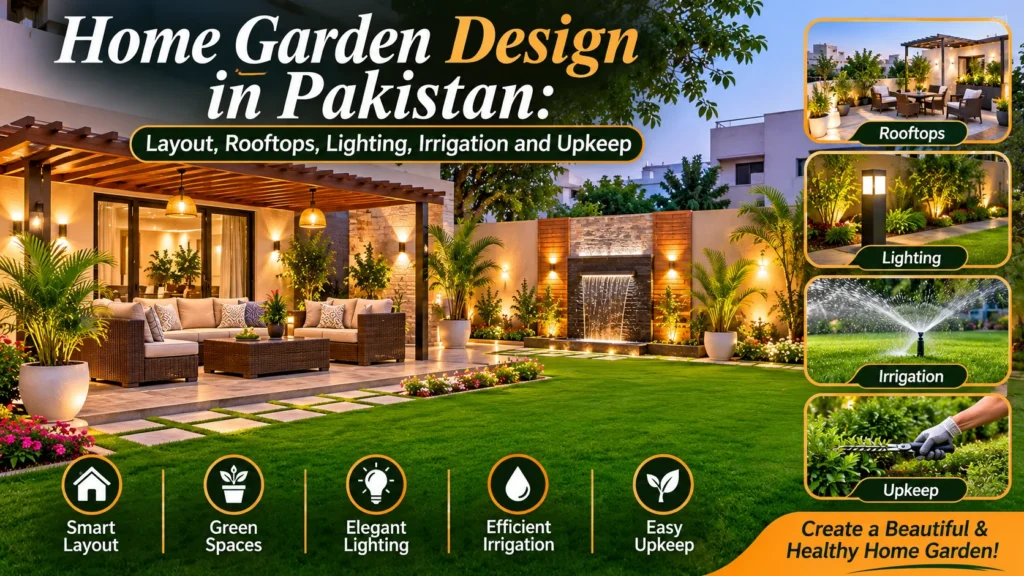
A good home garden is not a collection of plants. It is a plan: where you sit, where the water goes, what gets shade, what needs mowing, and how much time and money it will take to keep going. Plenty of gardens in Pakistan start well and then decline within two seasons because the plan ignored heat, water or upkeep.
This guide covers the whole job in order: how to design a home garden, what the climate demands in different parts of Pakistan, ideas for small gardens, how to build a rooftop or terrace garden, how to light a garden, how to set up lawn irrigation, and what garden maintenance services actually do.
Home garden design: where to start
Landscape design for a home means deciding how the outdoor space will work before anything is bought or planted. A designer, or you, should answer five questions first:
- Who uses the garden, and for what? Children playing, evening tea, family gatherings, growing vegetables, or simply something green to look at from indoors.
- What are the site conditions? Sun and shade through the day, soil type, slope, existing trees, boundary walls and where rainwater collects.
- How much water is available? Mains pressure, a motor and tank, a tube well, or limited supply. This sets the size of the lawn and the plant choice.
- How much upkeep can you manage? A garden that needs daily work will not stay good without a gardener or a maintenance contract.
- What is the budget, in two parts? The cost to build, and the monthly cost to maintain.
A complete home garden design usually includes a measured plan, a layout of lawn, paths, seating and beds, a planting plan with species and spacing, drainage and irrigation, lighting, and a material list. If you want this done for your house, see our landscape design for home service.
Front, side and back gardens
Each part of the plot does a different job. The front garden is the face of the house and needs a tidy, low-effort design: a clear path, a feature tree or hedge, and plants that survive without constant attention. Side strips are often narrow and shaded, and suit ferns, shade-tolerant plants and gravel paths. The back garden is where the family spends time, so it gets the lawn, seating and play space. For ideas aimed at the back of the house, see our guide to backyard landscaping ideas for Pakistan.
Garden design in Pakistan: what the climate asks for
Pakistan covers very different growing conditions, and a design that works in one city can fail in another.
- Punjab plains (Lahore, Faisalabad, Multan): very hot summers, a humid monsoon, cool winters with occasional frost. Shade, heat-tolerant plants and good drainage matter most. Our guide to landscaping in Lahore covers this region in more detail.
- Karachi and the coast: mild winters, strong sea wind and salt in the air. Choose salt-tolerant plants such as bougainvillea, date palms and some grasses, and protect softer plants from wind.
- Islamabad and Rawalpindi: cooler summers and real winter cold, with frost on some nights. A wider plant choice is possible, including many flowering shrubs and cool-season lawns, but tender plants need winter protection.
- Quetta and the highlands: dry air, cold winters and low rainfall. Drought-tolerant and frost-hardy plants do best, and water use should be planned carefully.
Whichever region you are in, buy plants from a local nursery that raises them in your conditions, and ask what has survived in gardens nearby.
Small garden design ideas
A small garden is easier to maintain and easier to get wrong. Most failures come from trying to fit too much in. These ideas help:
- Choose one main purpose. A seating corner, a small lawn or a planted retreat. Do not try to do all three.
- Keep the design simple. Few materials and a limited colour range make a small space look larger.
- Use the vertical space. Trellises, wall planters and climbers such as jasmine or bougainvillea add greenery without taking floor area.
- Choose scale carefully. One medium tree or tall shrub gives more impact than several small plants, and a large pot looks better than many tiny ones.
- Lead the eye. A curved path, a focal pot or a bench at the far end makes the garden seem longer.
- Use containers. Pots let you change the look with the season and move plants out of harsh sun.
- Pick furniture that folds or stacks. It frees space when you need it.
- Add light in the evening. A few lights extend the use of a small garden after dark.
Rooftop garden and terrace garden design in Pakistan
Rooftops and terraces are often the only open space in a city house, and a rooftop or terrace garden can be both cooling and pleasant. They are also harder to build well than a garden on the ground, because mistakes can leak water into the rooms below.
Check the structure first
Wet soil, water and large planters are heavy. Before building, ask a structural engineer whether the slab can carry the load. Place the heaviest planters over beams and walls rather than the middle of a span, and keep the weight spread out.
Waterproofing and drainage
- Repair any cracks and make sure the roof has a good waterproof layer before adding anything.
- Use a root-resistant barrier under raised beds and large planters.
- Add a drainage layer and filter fabric so water leaves the soil without carrying soil away.
- Never block roof drain outlets. Keep access to them so they can be cleared before the monsoon.
- Use planters with drainage holes, raised slightly on feet so water can flow out beneath.
Soil, plants and containers
- Use a light growing mix, for example a blend of garden soil, compost and cocopeat or perlite, instead of heavy clay soil.
- Choose plants that tolerate heat and wind: succulents, aloe, bougainvillea in large pots, lantana, ornamental grasses, herbs, and lemon or other citrus in big containers.
- Group pots by water need so a drip line can serve each group.
- Mulch the surface of pots and beds to keep soil cooler and reduce watering.
Heat, wind and safety
- Provide shade with a pergola, shade net or sail. Bare slabs get very hot in summer.
- Anchor tall pots, trellises and furniture. Pre-monsoon dust storms and monsoon winds can throw loose items off a roof.
- Check that the parapet or railing is high and solid enough, especially if children use the space.
- Run a tap and drip line to the roof if possible, so plants are not carried water by hand.
- Keep the water tank and its access clear of planters.
A terrace garden on an upper floor works the same way, but is usually smaller and sits next to living space, so privacy screens, seating and lighting matter as much as the planting.
Garden lighting design
Good garden lighting makes a space safer and lets you use it after sunset, when Pakistani summers are bearable. The aim is a few well-placed lights, not a bright garden.
Types of garden light and where they go
- Path and step lights: low lights that show where to walk, with the fitting hidden if possible.
- Uplights: a small light at the base of a tree or tall plant that shines up through the leaves.
- Spotlights: for a wall, statue or feature plant.
- Wall lights: at doors, seating areas and the edge of a patio.
- String lights: over a pergola or seating corner, for a soft glow.
- Security lighting: brighter, directed at gates and dark corners, kept separate from decorative light.
Power, weather rating and colour
- Low-voltage LED systems are safe and efficient. Solar lights avoid wiring and keep working through load shedding, but their output drops on cloudy, foggy or smoggy days, so use them for decoration rather than safety-critical spots.
- Weather rating. Fixtures exposed to rain should be rated IP65 or higher.
- Lay cable in conduit before paving or planting, away from irrigation pipes, and have a qualified electrician make the connections.
- Warm white looks natural on plants and stone, and warm light tends to attract fewer insects than cool white.
- Aim lights down or across, and avoid shining straight into eyes or neighbours’ windows.
We install lights as part of full gardens and also separately, as described on our garden lighting design page.
Irrigation system for lawn and garden
Watering by hose wastes water and time, and results depend on who is holding the hose. An irrigation system for your lawn waters evenly, on a schedule, and with less water. This matters in Lahore, where groundwater levels have been falling for years.
Main parts of a system
- Water source: mains, an overhead tank, or a motor and tank. Know the pressure and flow before you design.
- Filter: keeps sand and debris out of nozzles and drip lines.
- Pipework and valves: mains pipe, with a valve for each zone.
- Sprinkler heads: pop-up sprinklers for lawns, which rise when water flows and sink back when it stops.
- Drip lines or emitters: for flower beds, shrubs, hedges and trees, delivering water slowly at the roots.
- Controller or timer: switches zones on and off at set times. A rain sensor is a useful addition.
Design points that make it work
- Divide into zones. Lawn, sunny beds and shaded beds need different amounts of water, so each zone gets its own valve.
- Overlap coverage. Sprinkler spray should reach the next head so there are no dry gaps.
- Do not mix sprinklers and drip on one zone. They deliver water at very different rates.
- Water early in the morning. Less is lost to evaporation, and the grass dries before evening.
- Water deeply, not often. Deep watering a few times a week in summer builds deeper roots than a little every day, though the right schedule depends on soil and grass type.
- Plan for load shedding. A timer that runs on a battery, or a schedule that matches when power and pressure are available, prevents missed watering.
- Look after it. Clean filters, check for blocked or broken heads, and flush the lines at the start of each season.
Garden maintenance services
Even a well-designed garden needs regular care, and this is where many owners rely on a gardener or a garden maintenance service.
What maintenance usually includes
- Lawn mowing, edging and watering checks
- Weeding and mulching of beds
- Pruning of shrubs, hedges and climbers
- Fertilising and pest and disease control
- Seasonal planting and replacing dead plants
- Irrigation and lighting checks
- Removal of garden waste
A year of garden care in the Punjab plains
- Spring (March to April): feed the lawn and beds, replace winter flowers, and check the irrigation system before the heat.
- Summer (May to June): increase watering, mow regularly, mulch, shade young or tender plants, and avoid heavy pruning in peak heat.
- Monsoon (July to September): watch drainage, pests and fungus, clear storm debris, and pull weeds quickly because they grow fast.
- Autumn (October to November): prune roses and shrubs, sow and plant winter flowers, and top-dress thin areas of the lawn.
- Winter (December to February): protect frost-sensitive plants, water less, and expect slower lawn growth.
Gardener services near me: how to choose
Searching for gardener services near you returns individual gardeners, nurseries and landscaping companies. An individual gardener can be a good, economical choice for a small garden, but the work depends on one person and stops when he is ill or away. A company usually provides supervision, tools, replacement plants and written terms. Whichever you choose, ask:
- How often will they visit, and for how long?
- What tasks are included in the monthly price, and what costs extra?
- Who supplies fertiliser, plants and chemicals?
- Who removes the garden waste?
- Can they show gardens they look after, and can you talk to the owners?
- What happens when plants die or the visit is missed?
You can see examples of finished gardens in our project gallery.
Frequently asked questions
What does a home garden design include?
A site survey, a layout plan showing lawn, paths, seating and beds, a planting plan, drainage and irrigation, lighting, and a list of materials. A good design also says how much upkeep the garden will need.
What is the best layout for a small garden?
Keep the plan simple: one main seating spot, one planting theme, plants that grow upward on walls and trellises, and pots to fill gaps. Avoid dividing a small space into many tiny areas.
Can I make a rooftop garden on my house in Pakistan?
Often yes, but the slab must carry the extra weight of soil, water and planters, and it must be properly waterproofed. Ask a structural engineer to check the roof before you start.
What is the best irrigation system for a lawn?
Pop-up sprinklers on a timer suit most lawns, and drip lines suit flower beds, shrubs and trees. Splitting the garden into zones lets each area get the water it needs.
What kind of lighting is best for a home garden?
Low-voltage or solar LED lights in a warm colour, with a weather rating of IP65 or higher for fixtures exposed to rain. Use a few well-placed lights on paths, steps and key trees rather than lighting everything.
How often does a garden need maintenance?
Most home gardens need a visit once a week during the growing season, with less frequent visits in winter. Lawn mowing, watering, weeding and pruning are the regular jobs, and fertilising follows the season.
What do gardener services include?
Typically mowing, watering, weeding, pruning, fertilising, pest control, seasonal planting and removal of garden waste. Ask for a written list of what each visit covers and how often it happens.
Plan your garden with Landscape Eperts
Whether you are designing a new garden, turning a rooftop into a green space, or looking for regular garden care, a short site visit is the best way to get a realistic plan and a written quotation. Contact Landscape Experts at [phone number] or [email address] to book a visit.