
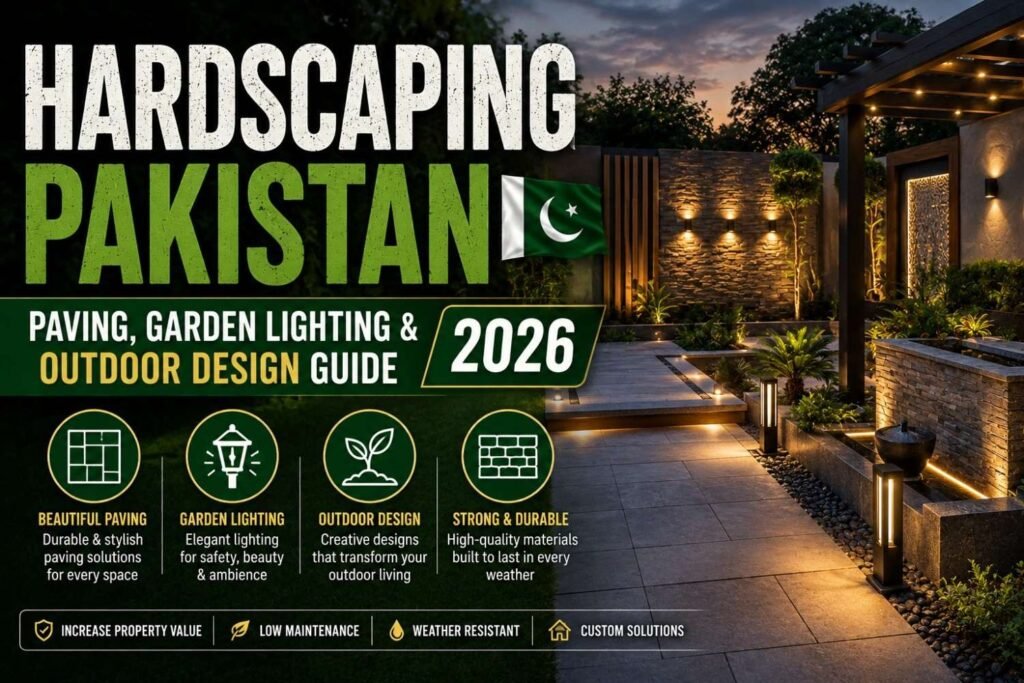
Hardscaping the structural, non-living elements of a garden design is the skeleton that gives every great Pakistani garden its form, function, and longevity. Lawns and planting are the garden’s beauty; hardscaping is its architecture. The patio where family gathers in the evening, the pathway that connects the gate to the front door, the raised bed walls that contain the kitchen garden, the steps that connect different garden levels, the boundary edging that separates lawn from border, and the garden lighting that brings it all to life after sunset these are the elements that make a garden genuinely usable, structurally coherent, and beautiful in all seasons and all weathers.
At Landscape Expert, hardscaping and outdoor lighting is one of our most technically demanding and most rewarding service areas. We design and install patios, pathways, steps, retaining walls, raised beds, edging, water channels, and professional garden lighting schemes across Pakistan. This complete guide covers everything Pakistani homeowners need to know about hardscaping and outdoor lighting in 2026 the materials best suited to Pakistan’s climate, the design principles that make hardscaping successful, and honest PKR cost guidance for all the major hardscaping elements.
| Key Takeaways Hardscaping Pakistan 2026
Hardscaping provides the structural framework that makes a Pakistani garden functional, beautiful, and long-lasting. Sub-base preparation is the most critical factor in patio and pathway longevity never compromise on this. Porcelain and natural stone are the best paving materials for Pakistani climate conditions. Solar-powered garden lighting eliminates load shedding from evening garden use. Garden lighting adds 30–40% to a garden’s evening usability and visual appeal. Hardscaping costs in Pakistan range from PKR 300–5,000 per square foot depending on material and specification. |
Why Hardscaping Quality Matters So Much in Pakistan
Pakistan’s climate is among the most demanding in the world for hardscaping materials and construction, which makes installation quality critical in ways that temperate climates simply don’t test. During summer, dark paving materials can reach surface temperatures of 60–70°C under direct sun. The monsoon season brings water volumes that place significant stress on drainage systems, exposing any weaknesses in the sub-base within just a few months. Thermal cycling from winter cold (including frost in Islamabad) to intense summer heat causes expansion and contraction stress in both materials and jointing compounds. Additionally, Pakistan’s clay soils, common across many of Lahore’s housing societies, can shift significantly under paving, expanding when wet and contracting when dry, which leads to cracking and settlement issues if the paving is poorly installed.
A patio built on an adequate sub-base with correctly specified materials, proper drainage gradient, and quality jointing compound can last 20 to 30 years in Pakistani conditions. In contrast, the same patio installed on an inadequate sub-base will typically begin showing cracking, settlement, and drainage problems within just one to three monsoon seasons. The difference in initial installation cost is relatively modest, but the difference in long-term durability and appearance over a decade is enormous.
Paving Materials for Pakistani Gardens A Complete Guide
Hardscaping Pakistan
Porcelain Pavers Premium, Durable, Beautiful
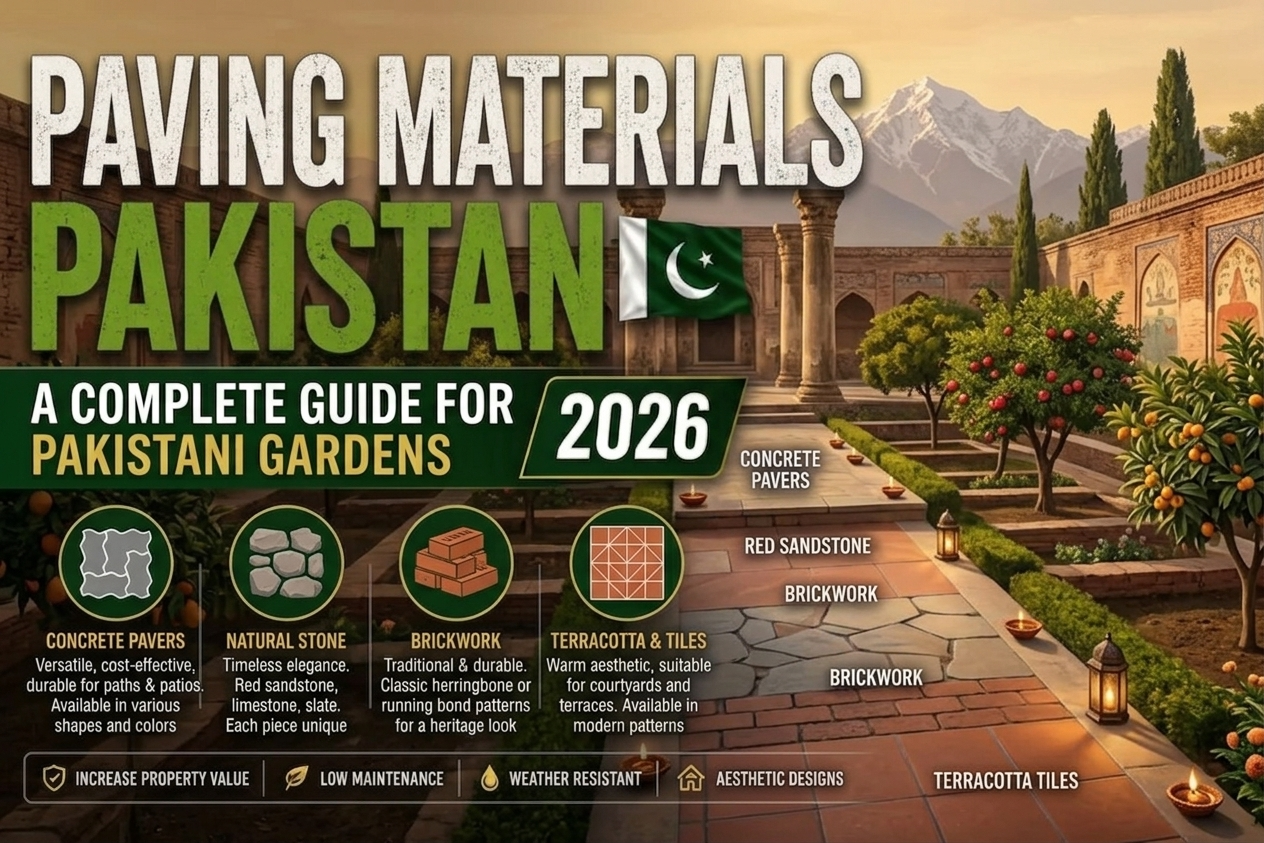
Porcelain paving has become the most popular premium paving choice for Pakistani housing society gardens in recent years and its popularity is entirely deserved. Porcelain pavers are extremely dense, virtually non-porous, resistant to staining, frost-proof, and require almost zero maintenance beyond occasional sweeping. They maintain their colour and surface quality through decades of Pakistani monsoon and summer without the fading, staining, or surface erosion that affects natural stone and concrete in the same conditions. They are available in large format sizes (600x600mm, 900x600mm, 1200x600mm) that suit contemporary garden aesthetics particularly well. The limitation is cost imported porcelain pavers cost significantly more than local natural stone or concrete and the need for professional installation on a properly prepared sub-base to avoid the cracking that poor installation causes.
Natural Stone Timeless and Locally Available
Pakistan has excellent local deposits of natural sandstone, limestone, and granite that produce high-quality paving material at significantly lower cost than imported porcelain. Natural sandstone from Punjab quarries in warm buff, grey, and multi-colour finishes is one of the most beautiful and appropriate paving materials for Pakistani garden patios. It suits traditional and contemporary garden styles equally well, weathers gracefully rather than deteriorating, and is available in a range of finishes from smooth sawn to rustic tumbled. Natural stone requires sealing every 3–5 years to maintain stain resistance, and some types (particularly lighter limestone) can stain from garden organics. It is more frost-sensitive than porcelain in Islamabad’s cold winters and should be installed with proper drainage gradients to prevent waterlogging.
Brick and Clay Pavers Traditional Character
Traditional clay brick pavers and stone sets create the most characterful and historically appropriate paving for older-style Pakistani homes and gardens. The warm terracotta tones of clay brick complement Pakistani architecture beautifully, and brick creates a genuinely timeless garden appearance. Clay bricks are durable in Pakistani conditions if properly fired and laid on a stable sub-base with correct jointing, though they are softer than porcelain or granite and more susceptible to surface wear in high-traffic areas over time. They are the most affordable natural paving option for Pakistani gardens when locally sourced from Punjab brick kilns.
Concrete Pavers Practical and Cost-Effective
Precast concrete pavers are the most affordable paving option for Pakistani gardens and are suitable for secondary areas, service pathways, and cost-sensitive projects where premium aesthetics are less important. Quality concrete pavers properly manufactured and laid perform adequately in Pakistani conditions, though they lack the visual quality of natural stone or porcelain. They are available in a range of sizes, colours, and surface textures that can achieve acceptable results in garden contexts. The main limitations in Pakistani conditions are colour fading over time in intense sun and the tendency to crack if the sub-base settles under monsoon water movement.
Sub-Base Preparation The Non-Negotiable Foundation
The most common reason Pakistani garden patios and pathways fail prematurely cracking, settling, becoming uneven is inadequate sub-base preparation. A paving surface is only as stable as what lies beneath it. Landscape Expert’s standard sub-base specification for garden paving in Pakistan: excavate to 250–300mm below final finished level; compact the native soil (treat any soft or waterlogged spots with hardcore compaction); lay 150mm of well-graded hardcore (crushed stone or recycled concrete) and compact thoroughly; lay 50mm of sharp sand as a bedding layer; lay the chosen paving material on a full mortar bed with correct jointing compound. This full specification adds cost compared to shortcuts (laying directly on compacted sand, using inadequate bedding depth) but produces paving that will last decades rather than failing after the first or second monsoon season.
Garden Lighting Pakistan Solar-Powered for Load Shedding Resilience
Why Solar Garden Lighting Is the Right Choice for Pakistan
Conventional WAPDA-connected garden lighting has an obvious and fundamental problem in Pakistan when the power goes out which in many areas happens for 6–12 hours during summer the garden goes dark during the exact evening hours when it is most used. Solar-powered garden lighting completely eliminates this problem. Solar LED fixtures charge through sunlight during the day and automatically switch on at dusk, providing consistent, reliable evening illumination regardless of WAPDA supply. Modern solar garden lights have improved dramatically in output and reliability over the past 3–4 years the generation of solar fixtures available in 2026 provides genuine illumination quality comparable to mains-powered equivalents in most garden lighting applications.
Types of Garden Lighting for Pakistani Outdoor Spaces
A complete Pakistani garden lighting scheme typically combines several fixture types to create a layered lighting design. Pathway lights low-level solar bollards or ground-flush lights along garden pathways improve safety and create beautiful guiding lines through the garden at night. Feature uplighting solar spotlights positioned at the base of trees, specimen plants, or garden walls and directed upward creates dramatic nighttime feature illumination that transforms the garden’s character after dark. Patio string lights or overhead festoon lighting solar-powered LED strings stretched across the patio area overhead create beautiful ambient evening light that makes the patio area feel like an outdoor room. Structure lighting integrated LED strip lighting in pergolas, gazebos, and covered structures provides functional and decorative lighting for outdoor sitting areas through load shedding evenings.
Garden Lighting Costs in Pakistan PKR Guide 2026
| Lighting Type | Typical PKR Cost Range (Installed) |
| Solar pathway lights (per light) | PKR 1,500–5,000 per fixture depending on quality |
| Solar spotlights/uplighting (per light) | PKR 2,000–8,000 per fixture |
| Solar string/festoon lights (per metre) | PKR 800–2,500 per metre |
| LED strip lighting for pergola/structure | PKR 500–1,500 per metre |
| Complete garden lighting scheme (10 Marla) | PKR 40,000–1,50,000 for full solar scheme |
| Solar pathway lighting only (10 Marla) | PKR 20,000–60,000 |
Hardscaping Costs in Pakistan Complete PKR Guide 2026
| Hardscaping Element | Unit | PKR Cost Range | Notes |
| Porcelain paving (imported) | Per sq ft | PKR 400–1,200 | Includes material, bedding, and jointing |
| Natural sandstone paving (local) | Per sq ft | PKR 250–600 | Local stone — excellent value |
| Brick/clay paver | Per sq ft | PKR 150–350 | Most affordable natural option |
| Concrete paver (precast) | Per sq ft | PKR 100–250 | Budget-friendly secondary areas |
| Garden pathway construction | Per running foot | PKR 300–800 | Depends on width and material |
| Raised bed (brick/natural stone) | Per running foot | PKR 800–2,500 | Height-dependent |
| Garden edging (steel/brick) | Per running foot | PKR 200–600 | Separating lawn and borders |
| Retaining wall | Per sq ft of wall face | PKR 600–2,000 | Depends on height and material |
FAQ Section
Q: What is hardscaping in a garden?
A: Hardscaping refers to all the non-living, structural elements in a garden design the patios, pathways, steps, retaining walls, raised beds, garden edging, boundary walls, water features, and lighting that give a garden its structural framework. In contrast to softscaping (the plants, lawns, and living elements), hardscaping provides the architectural bones that make a garden functional, organised, and durable. In Pakistani garden design, hardscaping is particularly important because high-quality hard surfaces extend the usability of the garden through all seasons a beautiful patio allows outdoor living in both dry spring weather and the hot summer months, while quality garden lighting extends the garden’s use into the evenings regardless of load shedding. Landscape Expert provides complete hardscaping services across Pakistan design, supply, and installation of all hard garden elements.
Q: What is the best paving material for gardens in Pakistan?
A: The best paving material for Pakistani gardens depends on the application and budget. For premium patios and main garden areas, imported porcelain pavers in a matt, large-format design are the most durable and lowest-maintenance option they maintain their appearance for decades with almost no upkeep. For a beautiful, natural, and cost-effective alternative, locally sourced natural sandstone from Punjab quarries provides excellent durability and character at significantly lower cost than porcelain. For traditional or heritage-style garden settings, clay brick pavers create the most characterful and historically appropriate surface. For budget-sensitive secondary areas and pathways, quality precast concrete pavers provide acceptable results at the lowest cost. Landscape Expert provides all paving types and advises on the most appropriate material for each specific application and budget during the free site visit.
Q: How much does garden lighting cost in Pakistan?
A: Garden lighting costs in Pakistan depend on the scale of the scheme and the quality of fixtures used. A basic solar pathway lighting scheme for a 5–10 Marla garden (8–12 pathway lights) typically costs PKR 15,000–40,000 installed. A complete garden lighting scheme for a 10 Marla garden covering pathways, uplighting for 2–3 feature plants or trees, and patio string lights typically costs PKR 40,000–1,00,000. A comprehensive lighting scheme for a larger garden with multiple zones, feature uplighting, structure lighting for a pergola or gazebo, and high-quality fixture specifications typically costs PKR 1,00,000–2,50,000. All Landscape Expert garden lighting uses solar-powered fixtures no dependency on WAPDA supply and near-zero ongoing running costs.
Q: How long does garden paving last in Pakistan?
A: Well-installed garden paving lasts 20–30 years or more in Pakistani conditions with appropriate material selection and proper sub-base preparation. Porcelain pavers on a correct sub-base are essentially indefinite in durability the material itself is more durable than most alternative surfaces. Natural sandstone on a correct sub-base typically lasts 15–25 years before requiring any significant maintenance. The critical variable is sub-base preparation paving on an inadequate sub-base will begin showing cracking and settlement within 1–3 years regardless of the surface material quality. Landscape Expert never compromises on sub-base specification it is the foundation of everything that sits above it, and our guarantee on all hardscaping work depends on doing this correctly.
Q: Can garden lighting work during load shedding in Pakistan?
A: Yes Landscape Expert’s solar-powered garden lighting systems work completely independently of WAPDA and continue to operate normally through any load shedding period. Solar LED garden fixtures charge through sunlight during daylight hours and automatically activate at dusk, providing consistent evening illumination regardless of whether WAPDA power is available. Most quality solar garden lights provide 8–12 hours of illumination from a full day’s solar charging sufficient to light the garden through the full evening period. During extended cloudy or monsoon periods when solar charging is reduced, most quality solar fixtures have sufficient battery reserve for 2–3 nights of normal operation without a full solar day. Landscape Expert installs solar-powered lighting as standard on all garden and outdoor structure projects across Pakistan load shedding should never mean sitting in a dark garden.
| Ready to transform your garden’s structure with professional hardscaping and load-shedding-proof solar lighting? Landscape Expert designs and installs complete hardscaping schemes across Pakistan patios, pathways, raised beds, retaining walls, edging, and professional solar garden lighting for Lahore, Islamabad, Karachi, Rawalpindi, Multan, and Faisalabad. WhatsApp us for a free hardscaping assessment and PKR quotation. |