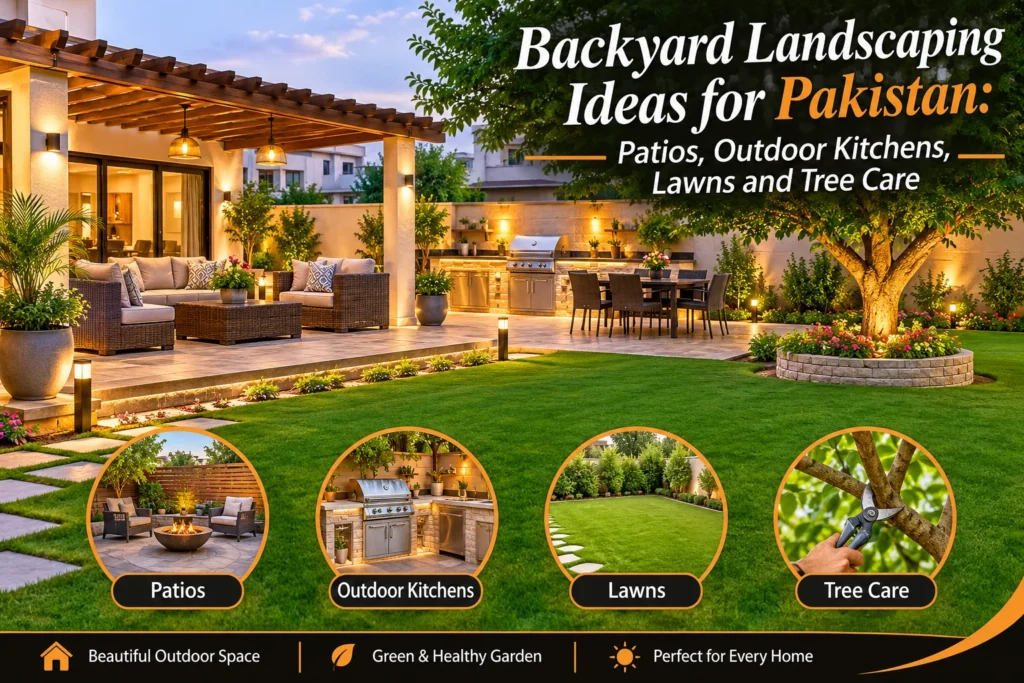
A backyard in Pakistan has to work harder than one in a cooler country. It faces strong summer sun, monsoon downpours, a short cold season, dust, and often limited water. The best designs are not the ones with the most features. They are the ones where shade, seating, plants and water supply have been planned together, so the space gets used in the evening and does not become a burden to maintain.
This guide collects practical landscaping ideas for backyards of different sizes, from a five marla house to a farmhouse plot. It covers patios, an outdoor cooking area with a kitchen garden, lawn care, and tree work, including what tree cutting costs and the permission rules in Lahore. If you want the wider background first, read our complete guide to landscaping in Lahore.
Landscaping ideas that suit Pakistan’s climate
Whatever the size of your yard, a few principles do most of the work:
- Start with shade. A pergola, shade sail or well-placed tree makes a yard usable on summer afternoons and evenings. Plan shade before plants or paving.
- Layer the planting. Put a hedge or tall plants at the back for privacy, shrubs in the middle and low flowers or groundcover at the front. Layers make a small yard look deeper.
- Choose plants for heat and low water use. Bougainvillea, oleander, lantana, duranta, jasmine, ornamental grasses and palms cope with Lahore summers better than thirsty flowering plants.
- Balance green and hard surfaces. An all-lawn yard needs a lot of water and mowing. An all-paved yard holds heat and floods in the monsoon. A mix of lawn, gravel, paved seating and planting beds works better.
- Add lighting. Low path lights and soft light on trees make the yard useful after sunset, when it is cooler.
- Plan water and drainage first. Decide where taps, drain points and, if possible, a drip line go before anything is laid.
- Use the walls. A green wall or climbers on a bare boundary wall add greenery when floor space is limited.
- Give the yard one focal point. A feature tree, a large planter, a small fountain or a seating corner gives the eye somewhere to rest.
Backyard landscaping ideas by size and use
Small backyards (five to ten marla)
Small yards need clear decisions. Pick the two or three things you will really use and drop the rest.
- A small lawn, or gravel and stepping stones in place of a full lawn
- A paved corner for two chairs and a table, shaded by a pergola or a climber such as bougainvillea or jasmine
- Planters and tall pots along the walls, so the middle stays open
- A vertical garden or trellis on the most visible wall
- One small tree in a corner for shade, chosen for modest roots and size
Large backyards and farmhouse plots
On a kanal plot or a farmhouse, the risk is the opposite: too much open space with no structure. Divide the land into zones.
- A formal front garden with a lawn, a clear path and a feature tree
- A shaded gathering area with a pergola or large paved patio
- An outdoor cooking area, kept downwind from the seating
- A kitchen garden or orchard corner
- A play area for children, away from the cooking zone and the driveway
- Tree groves or windbreak planting along the boundary for shade and privacy
Low-maintenance backyard ideas
- Use gravel, paving and planting beds for part of the area instead of lawn
- Group plants by water need and put them on a drip line
- Mulch beds so they lose less water and grow fewer weeds
- Choose shrubs and ornamental grasses that need only seasonal pruning
- Pick one grass type suited to your sun exposure rather than a mixed lawn
Backyard ideas for families with children
Children need open space, soft surfaces and shade. A level lawn, a shaded sandpit or a small play area with safe surfacing will be used more than an ornamental garden they are told not to touch. Keep thorny plants such as some bougainvillea types, and poisonous plants such as oleander, away from where small children play.
Backyard patio ideas
A patio is the part of the yard most likely to be used every day, so it is worth getting right. These are the surfaces commonly used in Pakistan:
- Anti-slip outdoor tiles. Easy to clean with a wide choice of looks. Choose a rough finish so they are not slippery after rain.
- Stamped or exposed-aggregate concrete. Hard-wearing and economical for larger areas. It needs expansion joints to limit cracking.
- Natural stone or brick. Good grip and a lasting look. It costs more and needs skilled laying.
- Gravel or pebbles. Cheap and drains well, but is uncomfortable underfoot in sandals and needs weed control.
- Timber decking. Warm in appearance, but sun, monsoon moisture and termites shorten its life unless it is well treated. Composite decking lasts longer.
Planning points that matter more than the finish:
- A patio on the east side of the house sits in the building’s shade in the afternoon. A west-facing patio needs a roof or a strong tree.
- Allow roughly three metres square for a table with four to six chairs, plus space to move around.
- Give it a slight fall away from the house, about one to two percent, so rainwater does not collect against the wall.
- Shade overhead. A pergola with climbers, a shade sail or a solid roof makes a big difference in May to September.
- Avoid standing water, add ceiling or pedestal fans, and keep dense damp planting away from the seating.
- Winter use. A fire pit or patio heater extends the season, but keep them well clear of trees, roofs and hanging fabric.
Farmhouse kitchen: an outdoor cooking area with a kitchen garden
In Pakistan a farmhouse is usually a larger plot outside the city, used for weekends and family gatherings, and cooking outdoors is part of that. A farmhouse kitchen in the landscape can be a simple barbecue counter or a covered kitchen with a tandoor, sink and seating.
- Place it downwind of the seating so smoke does not drift across guests, and close enough to the house for water, power and carrying food.
- A covered cooking area works through sun, rain and light dust. Keep the roof material and any hanging items clear of flames and heat.
- Use heat-resistant counters such as granite or stone, and tile or concrete floors that can be washed. Avoid bare timber near the fire.
- Gas, charcoal and wood-fired tandoors each need different ventilation. Store gas cylinders in a shaded, airy spot, away from heat.
- Water and drainage. A sink and a floor drain keep the area clean. Plan the pipework before paving.
- Fire safety. Keep overhanging tree branches away from the cooking area, and keep a fire extinguisher or sand bucket within reach.
- Lighting and power. Cooking after dark needs good task lighting and safe outdoor sockets.
A kitchen with a kitchen garden beside it is practical as well as pleasant. Herbs and vegetables a few steps from the cooking area get used. Mint, coriander, green chilli, tomato, brinjal, curry leaf, lemongrass, spinach and fenugreek are all common choices. Most vegetables need about six hours of sun, rich soil with compost, and regular watering, and raised beds make soil and drainage easier to control. Match the crops to the season, since winter greens and summer fruiting vegetables grow at different times. Curry leaf plants need protection from frost in winter.
Lawn care services: what to expect
A lawn is the most demanding part of a backyard, and the part most often neglected. Professional lawn care services usually cover a regular visit with the following work:
- Mowing at the right height and edging along beds and paths
- Watering checks and irrigation repairs
- Seasonal fertilising and weed control
- Top-dressing with soil or compost when the lawn thins
- Pest and disease treatment when needed
- Removal of clippings and garden waste
Lawn mowing near me: how to compare providers
When you search for lawn mowing near you, the results mix companies, individual gardeners and nurseries. Ask how often they will visit, what equipment they bring, whether fertiliser and weed treatment are included in the monthly price, and who removes the clippings. A monthly price that covers only mowing may cost more once the extras are added.
Tree services: cutting, pruning and removal
Check the permission rules first
Tree work in Lahore is now tightly controlled. In January 2026 the Parks and Horticulture Authority (PHA) banned the cutting, pruning and trimming of trees in Lahore without prior written approval, after the Lahore High Court criticised tree cutting along Canal Road. New Punjab regulations notified in March 2026 give special protection to large, old and ecologically significant trees, and say that moving a tree must be considered before cutting it. Some of these rules are aimed at public land and public projects, and how they apply to a tree in your own backyard can differ. Always confirm with the PHA or your housing society before anyone cuts or prunes a tree, and do not hire anyone who tells you permission is not needed without showing you why. Rules like these change, so check the current position.
How much does it cost to cut down a tree?
There is no honest fixed price, because trees differ so much. These are the factors that change the cost:
- Height, trunk thickness and spread of the crown.
- A tree in an open yard is simpler than one beside a wall, a roof or electricity lines, or one that cannot be reached by a vehicle.
- Climbing and cutting in sections costs more labour than felling in one piece, and a crane or lifting equipment adds to the bill.
- Dead, hollow or leaning trees need extra care.
- Clean-up. Removing logs, branches and leaves, and grinding or digging out the stump, are often priced separately.
- Time and paperwork for approval, where it applies.
- Number of trees. Several trees in one visit are usually cheaper per tree.
Ask for a written quotation that states how many trees, what work will be done, whether the wood and stump are removed, who obtains permission, and what happens if the job takes longer than planned. Compare at least two or three quotations on the same basis.
Alternatives to removing a tree
Many trees do not need to be cut down. Removing dead wood, lifting the lower crown for light and headroom, or thinning a dense crown can solve the problem, and a tree that is in the way of a project can sometimes be moved. Our guide to landscaping around trees explains how to design a yard so that existing trees stay healthy.
Safety
Do not cut large trees yourself. Falling branches, ladders and nearby electricity lines cause serious injuries every year. Keep well away from live wires, and use a tree service with experienced climbers and proper safety equipment.
Finding landscaping near me: landscapers, lawn and tree services
Searches for “landscaping near me”, “landscapers near me” and “tree services near me” all lead to a mixed list. A few checks separate reliable companies from the rest:
- See finished work. Look at our project gallery or any company’s photos, and ask to visit a site that is at least a year old.
- Ask about local conditions. A good company talks about summer heat, monsoon drainage and winter frost without being prompted.
- Ask who does the work. Find out which jobs the company does with its own team and which it subcontracts.
- Get everything in writing. Scope, materials, timeline, price and what is excluded.
- Ask about tree permission. For tree work, a reliable company will tell you what approval is needed and who will handle it.
- Choose one team for linked work. Design, planting, lawn care and tree work affect each other, and one company managing all four avoids gaps.
A sensible order of work for your backyard
- Measure the yard and decide how it will be used.
- Settle water supply, drainage, levels, and conduits for power and lighting.
- Decide which trees stay, and apply for any permission needed before touching them.
- Build the hard surfaces: patio, paths, walls, pergola and the outdoor kitchen.
- Prepare the soil and plant trees, shrubs and beds.
- Lay the lawn last, once heavy work is finished.
- Install lighting, furniture and finishing touches.
- Set up a regular maintenance routine for lawn, plants and trees.
Frequently asked questions
What are the best backyard landscaping ideas for Pakistan’s heat?
Start with shade from a pergola, shade sail or tree. Then use heat-tolerant plants such as bougainvillea, oleander, lantana and ornamental grasses, keep the lawn size sensible, and add a paved seating area that is shaded in the afternoon.
What is a good patio surface for a backyard in Pakistan?
Anti-slip outdoor tiles, exposed-aggregate concrete, brick and natural stone all work well. Choose a rough finish so the surface is not slippery after rain, and slope it slightly away from the house so water drains.
Can I build an outdoor kitchen in a house backyard?
Yes, if you have room for ventilation, a safe distance from trees and walls, a water supply and a drain. Gas cylinders need a shaded, airy spot. Check your housing society’s rules before building.
How much does it cost to cut down a tree in Pakistan?
There is no single price. The cost depends on the tree’s height and trunk size, access, whether wood and stump are removed, and how many trees are involved. In Lahore you also need written permission first. Ask for a written quotation that lists exactly what is included.
Do I need permission to cut a tree in Lahore?
The Parks and Horticulture Authority has banned cutting, pruning and trimming of trees in Lahore without written approval, and new Punjab regulations give extra protection to large and old trees. Confirm with PHA or your housing society before any tree work, including private plots.
How often do lawn care services visit?
Usually once a week for mowing during the growing season and less often in winter. Fertilising, weeding and edging are done on a seasonal schedule.
What should lawn care services include?
Mowing, edging, watering checks, fertilising, weed control, top-dressing when the lawn thins, and removal of clippings and waste.
Plan your backyard with LandscapeXperts
Whether you want a patio, an outdoor kitchen, a lawn that stays green, or advice on a tree you are unsure about, a site visit is the quickest way to get a clear plan and a written quotation. Contact LandscapeXperts at [phone number] or [email address] to arrange one.