Three forces are driving Pakistan’s kitchen gardening boom in 2026: rising vegetable prices, growing distrust of chemical pesticides in commercially grown produce, and a simple desire to know exactly what’s going into the food on the family table. From apartment balconies in Karachi to rooftop gardens in DHA Lahore and backyard raised beds in Islamabad’s F-sectors, more Pakistani households than ever are growing their own vegetables, herbs, and fruit at home and finding it far more achievable, rewarding, and cost-effective than they expected.
At Landscape Expert, kitchen garden design and installation is one of our fastest-growing services. We plan, build, and maintain professional kitchen gardens for homeowners across Lahore, Islamabad, Karachi, Rawalpindi, Faisalabad, and Multan from a simple 4-bed raised garden on a 5 Marla plot to a full 20-bed productive garden on a farmhouse. This guide covers everything you need to know to start, design, and maintain a kitchen garden in Pakistan in 2026.
Key Takeaways: Kitchen Gardening in Pakistan (2026)
- Pakistan’s climate supports year-round vegetable growing when crops are matched to the correct season.
- Raised beds are the best option for most Pakistani homes better drainage, better soil control, easier upkeep.
- The rabi season (October–March) and kharif season (April–September) each call for different crops.
- Soil quality is the single biggest success factor Pakistani urban soil almost always needs improvement before planting.
- 100% organic growing is fully achievable using vermicompost, neem oil, and companion planting.
- A professional kitchen garden setup from Landscape Expert costs PKR 25,000–2,50,000, depending on scope.
Why Kitchen Gardening Is Booming in Pakistan in 2026
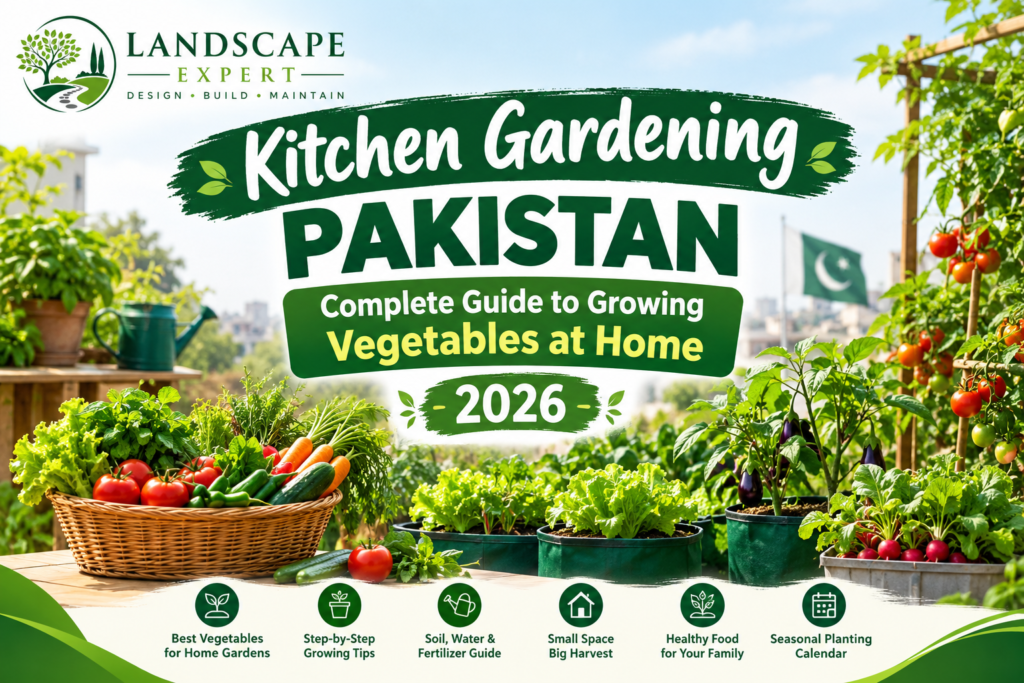
Kitchen Gardening Pakistan
Rising Costs and Food Safety Concerns
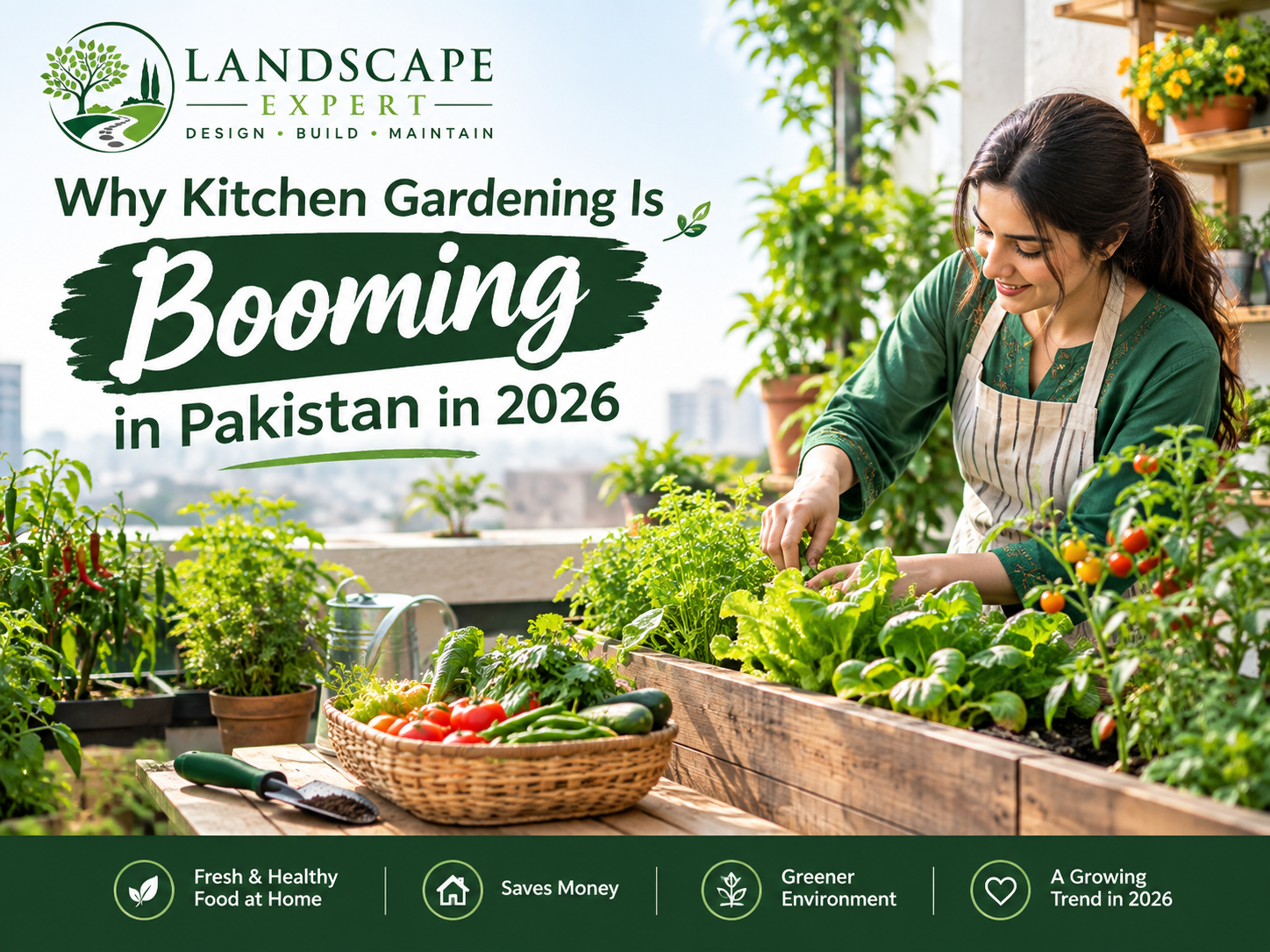
Vegetable prices across Pakistan have climbed sharply in recent years, pushing staples like tomatoes, onions, and spinach to price points that make homegrown alternatives genuinely attractive. Beyond cost, growing concern over synthetic pesticides, chemical fertilisers, and artificial ripening agents in the commercial supply chain has pushed health-conscious families toward growing their own food. A home kitchen garden solves both problems at once: the household eats what it grows, knows exactly what inputs were used, and harvests at true peak freshness instead of after days in a distribution chain.
Limited Space Is No Longer an Obstacle
A common misconception is that kitchen gardening needs a large plot. It doesn’t. A 4-bed raised garden fits comfortably along the side passage of a 5 Marla home. A rooftop kitchen garden using grow bags can be highly productive on as little as 50 square metres. A balcony setup with vertical planters and deep containers can produce herbs, chillies, tomatoes, and leafy greens year-round. Landscape Expert has installed productive gardens in spaces as small as 15 square metres and the yield from a well-designed small garden consistently surprises homeowners.
Pakistan’s Climate Is Genuinely Ideal for Year-Round Harvests
Pakistan’s climate outperforms most homeowners’ expectations for continuous vegetable production. Unlike the UK or northern Europe, where the growing window is compressed into a few warm months, Pakistan offers two full growing seasons: the rabi season (October–March), when cool-weather crops like tomatoes, spinach, peas, cauliflower, coriander, and potatoes thrive, and the kharif season (April–September), when heat-tolerant crops like okra, bitter gourd, bottle gourd, chillies, and cucumber perform best. With the right seasonal plan, a Pakistani kitchen garden can produce something edible almost every month of the year.
Choosing the Right Kitchen Garden Type for Your Pakistani Home
Raised Bed Kitchen Gardens: Best Choice for Most Homes
For residential properties, raised beds are what Landscape Expert recommends most often. Since a raised bed sits above the native soil, it bypasses the compacted, poorly draining, construction-grade fill common in Pakistani urban plots. The bed can instead be filled with a properly formulated growing mix compost, organic matter, and quality topsoil giving plants an ideal rooting environment regardless of what’s underneath. Raised beds also drain better, warm up faster in spring, and require far less bending to maintain. Landscape Expert builds these beds in treated timber, brick, or natural stone, based on the homeowner’s preference and the garden’s overall look.
Container and Grow Bag Gardens: Best for Rooftops and Balconies
For apartments, paved courtyards, or rooftops, container and grow bag gardening is an excellent fit. Large containers at least 40 litres for tomatoes and larger vegetables, 20 litres for herbs and chillies, and 60+ litres for dwarf fruit trees filled with quality potting mix and connected to drip irrigation can be surprisingly productive. Grow bags (porous, breathable fabric planters) have become especially popular for rooftop gardens in Pakistan because they’re lightweight (important where roof load is a concern), encourage healthier root growth, and are relatively inexpensive.
In-Ground Kitchen Gardens: For Properties with Good Soil
Where a property already has genuinely good, well-draining soil more common on older farmhouses or certain established plots around Lahore and Islamabad an in-ground kitchen garden remains a solid choice. The key first step is soil improvement: working in generous amounts of vermicompost, well-rotted farmyard manure, or regular compost to improve structure, drainage, and nutrient levels before planting. Even in-ground gardens benefit from clearly defined beds with permanent pathways, so growing soil is never walked on or compacted, keeping it loose and well-aerated for root development.
Pakistan’s Kitchen Garden Seasonal Planting Calendar
Getting seasonal timing right is the second most important factor in kitchen garden success, right after soil quality. Planting a heat-loving crop like okra in November guarantees failure not because of bad seed or a bad gardener, but simply because of bad timing. Here’s the seasonal planting calendar for kitchen gardens across Pakistan’s major cities.
| Crop | Best Season | Sowing Month | Ready to Harvest |
| Tomatoes | Rabi (cool season) | October–November | December–February |
| Spinach (Palak) | Rabi | October–November | December–March |
| Coriander (Dhaniya) | Rabi | October–March (continuous) | 2–3 weeks after sowing |
| Peas (Matar) | Rabi | October–November | December–February |
| Cauliflower & Cabbage | Rabi | September–October | December–February |
| Fenugreek (Methi) | Rabi | October–February | 3–4 weeks after sowing |
| Radish (Mooli) | Rabi | October–January | 3–4 weeks after sowing |
| Okra (Bhindi) | Kharif (warm season) | March–May | May–August |
| Bitter Gourd (Karela) | Kharif | March–April | May–August |
| Bottle Gourd (Lauki) | Kharif | March–April | May–August |
| Chillies (Mirchi) | Kharif | February–March (sow indoors) | May–October |
| Brinjal (Baingan) | Kharif | February–March (sow indoors) | May–September |
| Cucumber (Kheera) | Kharif | March–April | May–July |
| Mint (Podina) | Year-round | Any month | Continuous harvest |
| Lemon Grass | Year-round | March–April (best) | After 6–8 months |
Soil Preparation: The Most Critical Step
Landscape Expert’s kitchen garden installations across Pakistan consistently reveal the same challenge: most urban soil simply isn’t suitable for vegetables without preparation. Compacted clay-heavy soil in Lahore, saline coastal soil in Karachi, and construction-grade fill in newer housing societies none of it supports the root development, drainage, or nutrient availability that productive vegetable growing requires.
For raised beds, Landscape Expert uses a specifically formulated growing mix: 40% high-quality loam topsoil, 30% mature vermicompost or well-rotted farmyard manure, 20% coarse sand or perlite for drainage, and 10% coco peat for moisture retention. This mix is prepared and loaded during installation, creating an immediately productive environment regardless of the native soil below. For in-ground gardens, existing soil is improved with at least 30% organic matter by volume, then thoroughly turned and aerated before planting begins.
100% Organic Kitchen Gardening: Landscape Expert’s Commitment
Every Landscape Expert kitchen garden is built and maintained using 100% organic inputs zero synthetic pesticides, zero chemical fertilisers.
Fertilisation: vermicompost top-dressings, compost tea soil drench, and organic slow-release granular fertiliser applied seasonally.
Pest management: neem oil spray for fungal issues and soft-bodied pests, soap water spray for aphids, garlic-chilli solution as a general deterrent, and companion planting to naturally repel pests.
All Landscape Expert kitchen gardens are completely safe for children, pets, and Pakistan’s urban birdlife a key point of difference from conventional garden centres and landscaping companies that rely on chemical inputs.
Solar-Powered Irrigation: Solving the Load Shedding Problem
One of the most common causes of kitchen garden failure in Pakistan is inconsistent watering especially during load shedding, when the motor pump can’t run, and during summer heat, when daily watering is essential for crop survival. Landscape Expert installs solar-powered drip irrigation as standard on every kitchen garden project, eliminating the load shedding problem and ensuring vegetables get the right amount of water at the right time regardless of WAPDA supply.
A solar drip irrigation system for a typical 6-bed kitchen garden costs PKR 25,000–50,000 installed, including the solar panel, controller, main supply line, and individual drip emitters at each planting position. The system runs automatically on a timer, adjusting frequency and duration seasonally, and keeps working through any load shedding period. For homeowners who’ve previously lost crops to inconsistent summer watering, solar irrigation is genuinely transformative.
Kitchen Garden Setup Costs in Pakistan: 2026 PKR Guide
| Kitchen Garden Type & Size | Typical PKR Cost Range |
| Starter kit — 4 raised beds, soil, basic irrigation | PKR 25,000–50,000 |
| Standard setup — 6–8 raised beds, solar drip irrigation, seasonal plants | PKR 50,000–1,00,000 |
| Comprehensive — 10–12 beds, solar irrigation, herb border, fruit trees | PKR 1,00,000–2,00,000 |
| Premium farmhouse kitchen garden — 20+ beds, orchard integration | PKR 2,00,000–5,00,000+ |
| Rooftop container kitchen garden (20–30 containers) | PKR 35,000–80,000 |
| Balcony herb and vegetable garden (10–15 containers) | PKR 15,000–35,000 |
| Annual maintenance plan (per month) | PKR 5,000–15,000, depending on size |
Frequently Asked Questions
Q: How do I start a kitchen garden in Pakistan?
Starting a kitchen garden in Pakistan involves four steps. First, choose your setup type: raised beds work best for most homes, containers suit rooftops and balconies, and in-ground beds suit properties with good soil. Second, prepare your soil or growing mix this is the most critical step, since Pakistani urban soil almost always needs organic matter amendment before vegetables will thrive. For raised beds, use a mix of quality topsoil, vermicompost, coarse sand, and coco peat. Third, choose crops matched to the current season: rabi crops (October–March) include tomatoes, spinach, peas, coriander, and cauliflower; kharif crops (April–September) include okra, bitter gourd, chillies, and cucumber. Fourth, set up reliable irrigation ideally solar-powered drip irrigation that waters automatically regardless of load shedding. Landscape Expert can handle all four steps with a professional kitchen garden installation contact us for a free site assessment.
Q: What vegetables grow best in Pakistan’s climate?
Pakistan’s climate supports an excellent range of vegetables across two main growing seasons. In the rabi or cool season (October–March), top performers include tomatoes, spinach (palak), coriander (dhaniya), peas (matar), fenugreek (methi), radish (mooli), and cauliflower/cabbage. In the kharif or warm season (April–September), the most successful crops are okra (bhindi), bitter gourd (karela), chillies, brinjal (baingan), bottle gourd (lauki), and cucumber. Year-round performers include mint, lemon grass, and curry leaf.
Q: Can I have a kitchen garden on a rooftop in Pakistan?
Yes rooftop kitchen gardens are among the most popular and productive setups for urban homeowners. High sun exposure on rooftops actually favours most vegetables: tomatoes, chillies, okra, herbs, and leafy greens all perform very well there. Key requirements include a structural assessment to confirm the roof can bear the additional load (lightweight grow bags are usually well within limits), a waterproofing check, containers of sufficient size (minimum 40 litres for most vegetables), a lightweight growing mix rather than heavy garden soil, and automated preferably solar-powered irrigation, since rooftops dry out faster than ground-level gardens. Landscape Expert designs and installs complete rooftop kitchen gardens across Lahore, Islamabad, and Karachi.
Q: How much does a kitchen garden setup cost in Pakistan?
Costs depend on size, type, and specification. A starter garden with 4 raised beds, quality growing mix, and basic irrigation typically costs PKR 25,000–50,000. A standard garden with 6–8 raised beds, solar drip irrigation, and initial seasonal planting typically costs PKR 50,000–1,00,000. A comprehensive garden with 10–12 beds, solar irrigation, a herb border, and fruit tree integration typically costs PKR 1,00,000–2,00,000. Rooftop container gardens typically cost PKR 35,000–80,000 for a 20–30 container setup with irrigation. All figures are 2026 estimates Landscape Expert provides a free site assessment and detailed PKR quotation for every enquiry.
Q: Does Landscape Expert use organic methods for kitchen gardens?
Yes every Landscape Expert kitchen garden is built and maintained using 100% organic inputs, with no synthetic pesticides, chemical fertilisers, or artificial soil amendments. Fertilisation relies on vermicompost, compost tea, and organic slow-release granular fertiliser. Pest management uses neem oil spray for fungal issues and soft-bodied pests, soap water spray for aphids, garlic-chilli solution as a deterrent, and companion planting to naturally repel pests. Every Landscape Expert kitchen garden is safe for children, pets, and urban wildlife from day one the vegetables you harvest are genuinely chemical-free, which is the whole point of growing your own food in Pakistan.
| Ready to start growing your own organic vegetables at home? Landscape Expert installs professional kitchen gardens across Pakistan — Lahore, Islamabad, Karachi, Rawalpindi, Faisalabad, and Multan. Solar-powered irrigation. 100% organic. Seasonal crop planning included. WhatsApp us today for a free site assessment and let’s design the kitchen garden your family deserves. |