
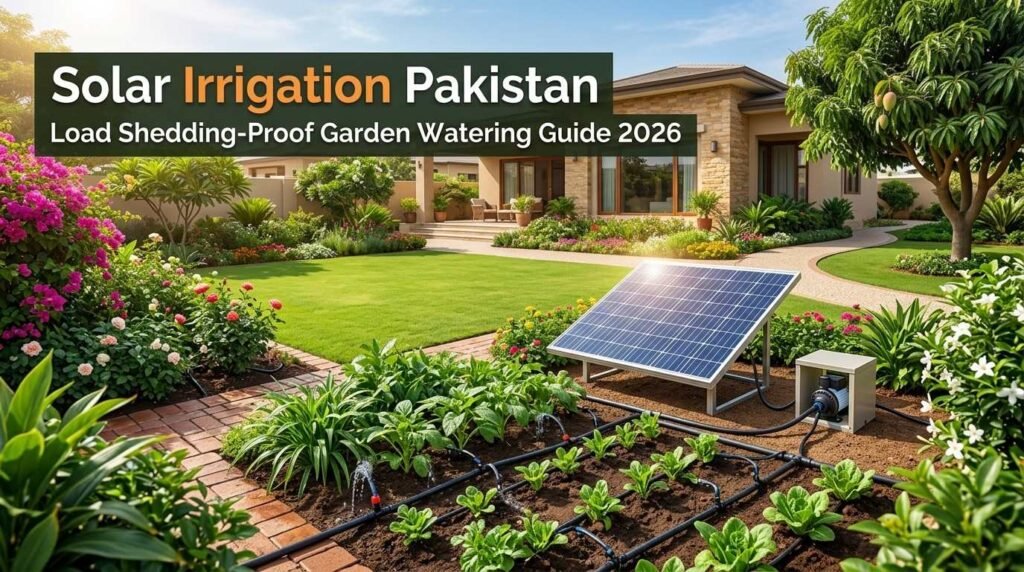
Solar Irrigation Pakistan offers a reliable, energy-efficient solution for keeping your garden watered even during frequent load shedding. Ask any Pakistani homeowner who has invested in a beautiful garden what their biggest ongoing frustration is and the answer is almost always the same: load shedding. Hours without WAPDA power mean the water motor pump cannot run, the irrigation system stops working, and the garden particularly during Pakistan’s intense May to August summer begins to suffer. New turf that took weeks to establish begins to brown within days of insufficient watering. Kitchen garden crops that were days from harvest wilt under 40°C+ summer heat without daily moisture. Newly planted shrubs that survived winter and spring face their first crisis when their first summer arrives without reliable irrigation.
Landscape Expert is Pakistan’s only professional landscaping company that installs solar-powered irrigation as a standard service offering specifically designed to eliminate the load shedding problem from Pakistani gardens permanently. Our solar drip and sprinkler irrigation systems operate completely independently of WAPDA supply, running automatically on a timer regardless of how long the power is out, ensuring your garden receives the right amount of water at exactly the right time, every day, throughout Pakistan’s most demanding summer months.
This complete guide covers everything Pakistani homeowners need to know about solar garden irrigation in 2026 from how the system works to which garden types benefit most, from cost guidance in PKR to a direct comparison with conventional WAPDA-dependent irrigation systems.
| Key Takeaways Solar Irrigation Pakistan 2026
Solar irrigation systems operate completely independently of WAPDA no load shedding interruption ever. A solar drip system for a 10 Marla garden costs PKR 60,000–1,20,000 installed typically recovering cost within 2 years. Solar irrigation dramatically reduces water waste compared to manual watering or conventional sprinkler systems. Kitchen gardens, lawns, rooftop gardens, and vertical gardens all benefit from solar irrigation. Landscape Expert is Pakistan’s only landscaping company actively promoting solar-powered garden irrigation as standard. Systems are available across all 6 cities Landscape Expert serves Lahore, Islamabad, Karachi, Rawalpindi, Multan, Faisalabad. |
Pakistan’s Load Shedding Problem and the Garden
solar irrigation pakistan
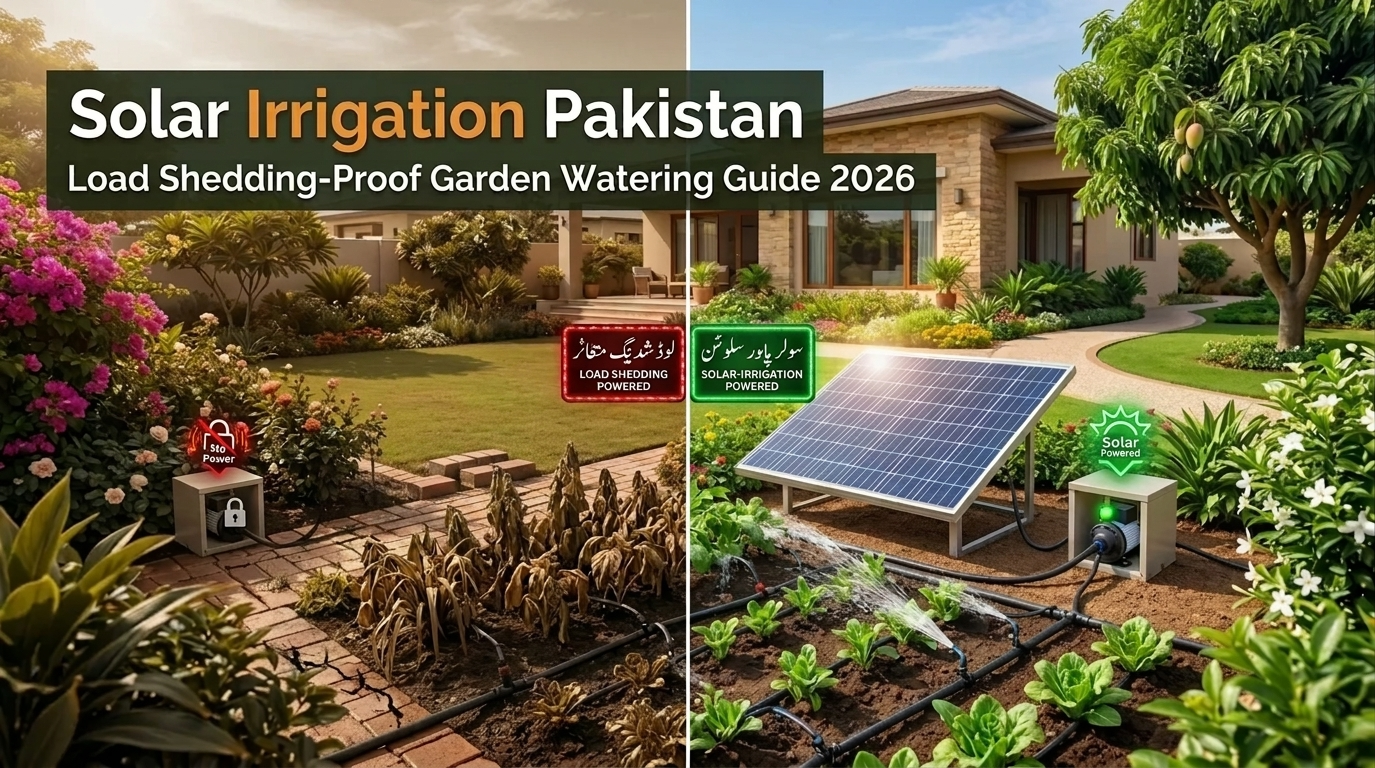
Why Load Shedding Is a Garden Disaster
Pakistan’s load shedding schedule which in many areas runs to 8–12 hours per day during peak summer months creates a genuinely serious garden management challenge. Most Pakistani garden irrigation systems depend on an electric motor pump to move water from the underground or overhead tank to the irrigation lines. When the power goes out, the pump stops, and the irrigation stops. In moderate weather this is a manageable inconvenience missing one watering cycle rarely causes permanent damage. But during Pakistan’s peak summer heat from June to August, when temperatures regularly exceed 40°C and newly established plants and lawns can be under genuine heat stress, missing even a single watering cycle can cause visible wilting within hours and permanent damage within days.
The Manual Watering Alternative Why It Fails
The typical Pakistani household response to irrigation failure caused by load shedding is manual watering hand-watering the garden whenever power happens to be available. This sounds workable in theory but consistently fails in practice, for several reasons:
- Time-consuming: Manually watering a 10 Marla garden takes 30–60 minutes of committed daily effort
- Timing-sensitive: It must be done at the right time of day early morning or evening, never during midday heat
- Inconsistent: Family schedules, work commitments, or simply forgetting on a particularly hot, tiring day mean plants regularly miss their watering
- Wasteful: Hand-watering applies water to the surface, where it evaporates rapidly, rather than delivering it directly to the root zone where it’s actually needed
- Unreliable during extended outages: When prolonged load shedding causes the household water tank to run dry and the motor pump can’t refill it, even manual watering becomes impossible
The Solar Irrigation Solution
A solar irrigation system eliminates every one of these problems simultaneously. A solar panel mounted on the rooftop or in a sunny garden position converts sunlight to electricity, charging a battery bank that powers the irrigation controller and pump system completely independently of WAPDA. The system runs on a timer, automatically watering at the programmed times regardless of power availability. It applies water precisely drip emitters deliver water directly to each plant’s root zone at the right rate, dramatically reducing waste compared to manual watering or overhead sprinklers. And it continues working during extended load shedding without any intervention required.
How Solar Garden Irrigation Works System Components
| System Component | Function |
| Solar Panel (100W–300W depending on system size) | Converts sunlight to electricity to charge the battery and power the pump |
| Battery Bank (12V–24V deep cycle batteries) | Stores solar energy to power the system during night-time watering cycles and during cloudy periods |
| Irrigation Controller | Programmable timer that controls when and how long each irrigation zone runs — typically set for early morning watering |
| Low-Voltage DC Pump or Pressure Reducer | Moves water from tank/mains supply through the irrigation lines at the correct pressure for drip emitters |
| Main Supply Line (16–25mm polyethylene pipe) | Primary water distribution line from pump to garden zones |
| Sub-main and Lateral Lines (12–16mm pipe) | Secondary distribution lines running through each garden bed or border |
| Drip Emitters / Micro-sprinklers | End-point water delivery — drip emitters for borders and kitchen gardens, micro-sprinklers for lawns |
| Filter (disc or mesh filter) | Prevents sediment from blocking emitters — essential for long system life |
| Fertiliser Injector (optional) | Allows liquid organic fertiliser or compost tea to be injected directly into the irrigation water |
Which Garden Types Benefit Most from Solar Irrigation
Kitchen Gardens The Greatest Beneficiary
Kitchen gardens are the garden type that benefits most dramatically from solar irrigation and load shedding-proof, consistent watering is the single biggest factor in kitchen garden success or failure during Pakistan’s summer. Vegetable crops are less drought-tolerant than ornamental plants: tomatoes that miss a day’s watering in 40°C heat show visible stress within hours and can develop blossom end rot (a calcium deficiency triggered by irregular water supply) that ruins the fruit even after watering resumes. Chilli and brinjal plants that experience water stress shed their flower buds directly reducing the harvest. Leafy greens like spinach bolt to seed immediately under heat and drought stress, ending their productive life prematurely. Solar drip irrigation, delivering the right amount of water consistently every morning regardless of load shedding, eliminates all of these problems.
Lawns Protecting a Major Investment
A newly laid lawn represents a significant investment PKR 35,000–1,30,000 for a 10 Marla garden depending on grass species and ground preparation. That investment can be damaged or destroyed within two weeks by inconsistent irrigation during summer heat. Established lawns are more resilient but still require regular water to maintain the lush green appearance that is the whole point of the lawn. A solar micro-sprinkler system for a lawn delivers water evenly across the entire lawn area at programmed intervals, maintaining consistent soil moisture through Pakistan’s driest months without any manual effort.
Rooftop Gardens Where Irrigation Is Most Critical
Rooftop gardens face the most demanding irrigation requirements of any garden type in Pakistan higher wind exposure, more intense sun, and faster substrate drying combine to create a situation where plants can require watering every 12–24 hours during peak summer. Manual watering of a rooftop garden requires climbing stairs with watering equipment in 40°C+ heat a genuinely unpleasant and often skipped task. Solar drip irrigation on a rooftop garden runs automatically at the programmed time, ensuring every container and planted bed receives the right water amount regardless of the temperature, load shedding schedule, or the homeowner’s other commitments.
Vertical Gardens Automated Micro-Irrigation Essential
Vertical garden systems felt pocket walls, modular panel systems, hydroponic frames all require regular, precise irrigation that is difficult to achieve manually on a wall-mounted system. Solar-powered micro-irrigation is the standard approach for all Landscape Expert vertical garden installations, with individual drip emitters or weeping hose systems running through the planting layers ensuring every plant receives moisture at the right rate. Without automated irrigation, vertical gardens typically fail within weeks during Pakistan’s summer the combination of wall heat absorption, air exposure, and the relatively small substrate volume in each pocket means rapid drying that manual watering cannot address consistently enough.
Solar Irrigation Costs in Pakistan PKR Guide 2026
| System Type | Garden Size | PKR Cost Installed | Annual Running Cost |
| Solar Drip (kitchen garden) | 6–8 beds | PKR 25,000–50,000 | Near zero — solar powered |
| Solar Drip (border planting) | 5–10 Marla garden | PKR 35,000–70,000 | Near zero |
| Solar Micro-sprinkler (lawn) | 5–10 Marla lawn | PKR 40,000–80,000 | Near zero |
| Solar Drip + Sprinkler (complete garden) | 10 Marla–1 Kanal | PKR 60,000–1,50,000 | Near zero |
| Rooftop solar drip system | 20–100 sqm rooftop | PKR 30,000–80,000 | Near zero |
| Vertical garden micro-irrigation | Per sq meter of wall | PKR 3,000–6,000/sqm | Near zero |
| Farmhouse/large estate system | 2 Kanal+ | PKR 1,50,000–5,00,000 | Near zero |
| Solar Irrigation vs Conventional — Pakistan Cost Comparison
Conventional WAPDA-dependent irrigation running cost: PKR 2,000–8,000/month in electricity during summer peak. Solar irrigation running cost: Near zero — sunlight is free after the initial installation investment. Average payback period for solar irrigation investment in Pakistan: 18–30 months depending on system size. Water savings vs manual watering: Drip irrigation uses 30–50% less water than conventional manual watering methods. Plant survival rate during load shedding: Solar system = near 100% / Conventional system = significant losses in hot summers. |
FAQ Section
Q: What is solar irrigation and how does it work in Pakistan?
A: Solar irrigation is a garden watering system powered by solar panels rather than WAPDA electricity making it completely independent of load shedding. The system works as follows: a solar panel mounted on the rooftop or in a sunny position converts sunlight to electricity, charging a battery bank. The battery powers an irrigation controller (programmable timer) and a low-voltage pump. The controller activates the pump at the programmed watering times typically early morning which pushes water through the irrigation network: main supply lines, sub-main lines, and individual drip emitters or micro-sprinklers at each plant position. The system continues operating automatically during any load shedding period because it runs from battery power charged by sunlight, with no dependency on WAPDA supply whatsoever. Landscape Expert installs solar irrigation systems across all garden types in 6 Pakistani cities.
Q: How much does solar irrigation cost in Pakistan?
A: Solar irrigation system costs in Pakistan depend on the size of the garden and the type of system required. A solar drip irrigation system for a kitchen garden with 6–8 raised beds typically costs PKR 25,000–50,000 installed. A complete solar drip and sprinkler system for a 10 Marla residential garden covering borders, lawn, and planting beds typically costs PKR 60,000–1,50,000. Rooftop garden solar drip systems cost PKR 30,000–80,000 depending on the rooftop area and number of containers. Large estate or farmhouse solar irrigation systems can range from PKR 1,50,000 to PKR 5,00,000 or more. Despite the upfront investment, solar irrigation systems typically recover their cost within 18–30 months through eliminated electricity costs, reduced water waste, and avoided plant replacement costs from load shedding irrigation failures.
Q: Does solar irrigation work during cloudy days and monsoon season?
A: Yes a properly designed solar irrigation system with adequate battery bank capacity continues to operate reliably during cloudy days and the monsoon season. The battery bank stores sufficient charge during the preceding sunny days to power the irrigation system through 2–3 days of minimal solar charging if needed. During Pakistan’s monsoon season (July to September), irrigation requirements are significantly reduced because natural rainfall provides much of the water plants need a good irrigation controller will have a rain sensor or manual programming adjustment to reduce or pause irrigation during monsoon periods, preventing overwatering. Landscape Expert programs every solar irrigation system with seasonal schedules that adjust automatically for different times of year, including reduced-frequency monsoon programming.
Q: Can solar irrigation be installed on an existing garden in Pakistan?
A: Yes solar irrigation systems can be retrofitted to existing gardens in Pakistan without needing to remove or significantly disturb established planting. The installation process involves: mounting the solar panel on the rooftop or in a sunny position; running the main supply line discreetly along boundary walls or beneath mulch in borders installing sub-main lines through each planting area; and placing individual drip emitters at each plant’s root zone. Established lawns require micro-sprinkler installation, which involves driving small stakes into the lawn surface with minimal disruption. The complete retrofit installation for a 10 Marla garden typically takes 2–3 days. Landscape Expert provides solar irrigation retrofits for existing gardens as a standalone service across all 6 cities.
Q: Is solar irrigation suitable for large gardens and farmhouses in Pakistan?
A: Yes solar irrigation scales effectively from small kitchen gardens to large farmhouse estates. For larger properties, the system simply uses larger solar panels, a larger battery bank, a higher-capacity pump, and more extensive pipe networks with multiple irrigation zones that activate sequentially rather than simultaneously. A typical 2 Kanal farmhouse estate might require a 500W solar panel, a 100Ah battery bank, a 0.5 HP DC pump, and a 4–6 zone irrigation controller to cover lawns, orchard, kitchen garden, and ornamental borders. Landscape Expert has installed solar irrigation systems on properties ranging from 3 Marla urban homes to 4 Kanal farmhouse estates the system design scales to match the property.
| Pakistan’s load shedding doesn’t have to mean a struggling garden. Landscape Expert installs solar-powered irrigation systems that keep your garden perfectly watered through every power outage automatically, efficiently, and at near-zero running cost. WhatsApp us for a free irrigation assessment across Lahore, Islamabad, Karachi, Rawalpindi, Multan, and Faisalabad. |